
Most of what determines your child’s dental health happens at home, not in our office. We see your child twice a year for about an hour total. Everything else — the brushing, the flossing, the habits that form (or don’t) — happens under your roof. That’s not a criticism. It’s just the reality of pediatric dental care, and it means the guidance we give parents matters as much as the treatment we provide.
This post covers what to do at each stage of your child’s development, how to handle the habits that worry parents most, and when something that seems minor is worth mentioning at the next visit.
Starting at the Beginning: Infant and Toddler Oral Care (Ages 0–3)
Oral care starts before teeth do. After each feeding, wipe your infant’s gums with a clean, damp cloth or a soft silicone finger brush. This removes milk residue and bacteria and establishes touch inside the mouth as normal, which makes the transition to toothbrushing much easier.
When the first tooth appears, usually around six months, introduce a soft-bristled infant toothbrush. Use a rice-grain-sized smear of fluoride toothpaste — not a full squeeze, not a pea-sized amount yet. The American Dental Association recommends fluoride toothpaste from the very first tooth because it is one of the most effective tools available for preventing early childhood cavities.
Around age three, increase to a pea-sized amount. At this point your child is also old enough to start learning technique, even if you’re still doing most of the work.
One thing worth saying plainly: if your child uses a pacifier, that’s fine. The concern is timing and intensity, not the habit itself. We’ll cover that in more detail below.
Teaching Brushing That Actually Works (Ages 2–8)
The two-minute standard exists for a reason — it takes roughly that long to cover all surfaces of all teeth when you’re doing it properly. For young children, two minutes is an eternity. Your job is to make it feel less like a chore and more like just a thing that happens.
A few approaches that work consistently:
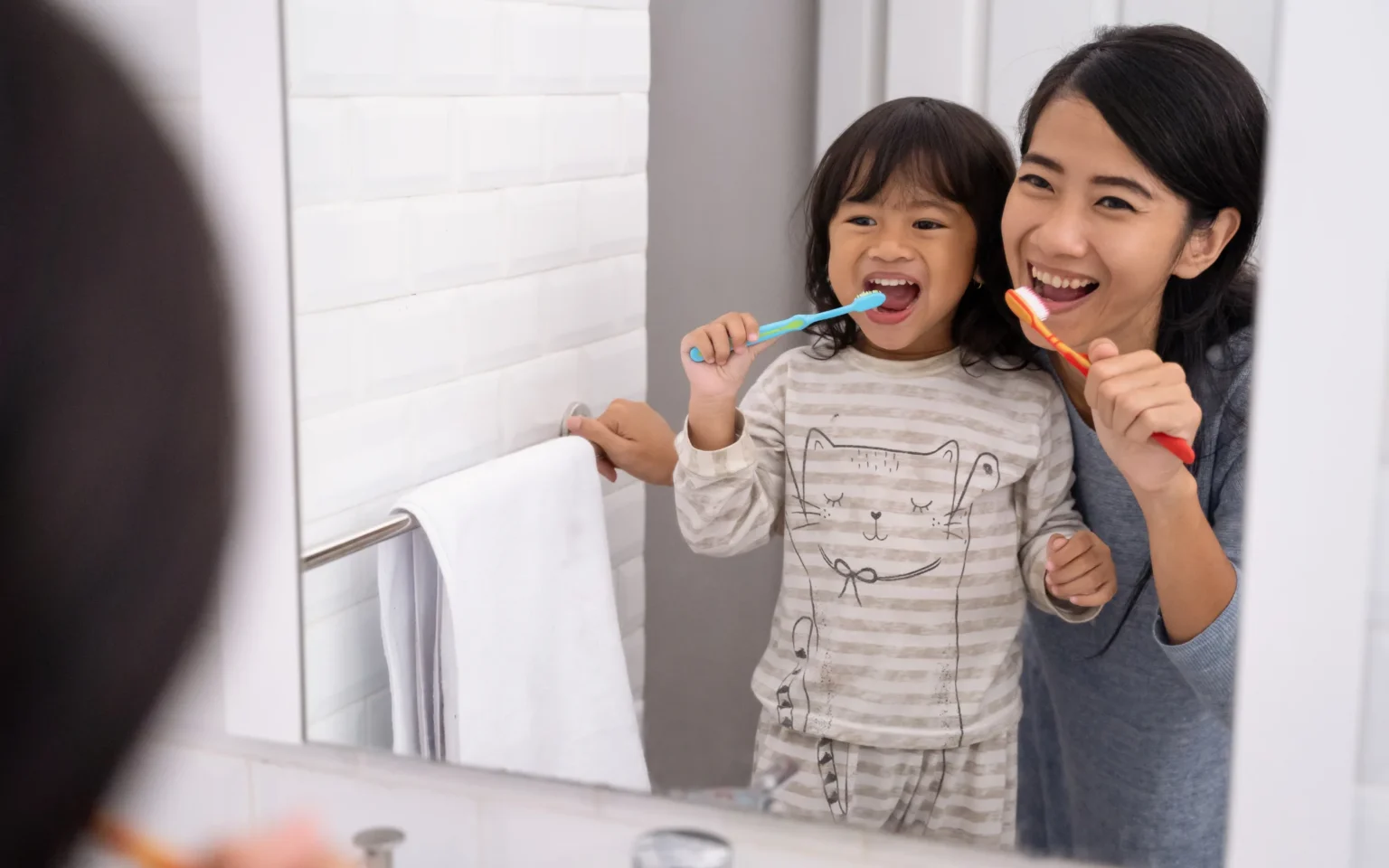
Brush together. Children this age learn by imitation. If they see you brush — and you make it look routine rather than reluctant — they absorb that it’s just what people do. Get matching toothbrushes, stand at the sink together, and treat it as time rather than a task.
Use a timer they control. A simple two-minute sand timer or a brushing app that plays a song gives the child ownership of when it ends. They’re not waiting for you to say stop — they’re watching the timer. This small shift reduces resistance significantly.
Electric toothbrushes are not a gimmick. For children who resist brushing, an electric toothbrush does more cleaning with less effort and less need for precise technique. Many children also find them genuinely interesting, at least initially. If the novelty fades, it’s still doing a better job than a manual brush used grudgingly.
Supervise longer than you think you need to. Most children don’t have the dexterity to brush their own back teeth effectively until around age seven or eight. Before that, the routine should be: child brushes first, parent finishes. Framing it as “my turn” rather than a correction keeps it from becoming a battle.
When and How to Introduce Flossing
Flossing becomes necessary as soon as two teeth sit close enough together that a toothbrush can’t reach between them. For many children this happens around ages two to three. You don’t need to wait for a specific age — watch for contact between teeth and start when you see it.
For young children, floss picks are far more practical than string floss. They require only one hand and give you much better control. As your child gets older and more coordinated, you can transition to string floss and teach proper technique — a C-shape around each tooth, sliding gently below the gumline rather than snapping straight down.
The honest reality is that most children resist flossing. The key is making it non-negotiable in the same way brushing is rather than something asked for and negotiated around. If it’s always done, there’s nothing to argue about. If it’s sometimes skipped, it becomes sometimes skippable.
Thumbsucking, Pacifiers, and What They Actually Do to Teeth
This question comes up constantly, and the answer is more nuanced than most parents expect.
The variable that matters most is not whether your child sucks their thumb or uses a pacifier — it’s how intensely they do it. A thumb resting passively in the mouth creates very little pressure on developing teeth. Aggressive, active sucking creates sustained pressure that can shift tooth position and affect the shape of the palate over time.
The age threshold that matters clinically is around four years old. Before that, most effects on tooth alignment are minor and self-correct naturally once the habit stops. If the habit continues actively past age four, particularly into the years when permanent teeth are beginning to develop, it’s worth a conversation.
What to do if you’re concerned:
- Don’t make it a daily battle for young children. Anxiety around the habit can intensify it.
- For children old enough to understand, involve them in the process. A child who wants to stop is far more likely to succeed than one who feels policed.
- Praise the absence of the habit rather than penalizing its presence.
- Bring it up at the next dental visit. We can assess what’s actually happening with tooth position and tell you whether any intervention makes sense.
We can offer specific strategies and, in cases where the habit is persistent and causing measurable dental changes, appliance options that help without relying on willpower alone.
Stress, Grinding, and the Habits That Show Up Under Pressure
Children grind their teeth. It’s more common than most parents realize. In most cases it’s not a sign of a serious problem, and many children grow out of it without intervention.
That said, there are things worth watching for. If your child wakes with jaw pain or headaches, complains that their teeth hurt, or if you can hear grinding clearly through the night, mention it at their next checkup. We can look for signs of enamel wear and assess whether the grinding is causing damage or just making noise.
Stress is a real contributor to bruxism in children. Academic pressure, family changes, and social stress can all manifest physically. This doesn’t mean every grinding child needs treatment. It means it’s worth paying attention and noting if it correlates with stressful periods.
Beyond grinding, stress can affect oral health in other ways: neglected brushing routines, increased snacking, mouth breathing during illness or anxiety, and canker sores. None of these are emergencies, but all are worth factoring into your child’s overall oral health.
If you notice your child’s habits slipping during a hard stretch, rebuild the routine rather than treating the lapse as a failure. Consistency over time matters far more than any individual missed night of flossing.
When Home Care Isn’t Enough — What the Dentist Catches That You Can’t
Even the most diligent home routine has limits. Decay between teeth isn’t visible without X-rays. Early gum changes aren’t something a parent can detect by looking. Developmental concerns with bite, jaw alignment, or incoming permanent teeth require a trained eye and sometimes imaging.
This is what twice-yearly visits are actually for — not cleaning teeth that are already clean, but catching the things that home care can’t address and establishing a record of your child’s development over time.
Professional dental cleanings remove calculus buildup that brushing cannot reach, and fluoride treatments deliver higher concentrations directly to the enamel surface than toothpaste alone. For children at higher risk for cavities, dental sealants add protection to the back teeth where most childhood decay starts.
Home care and professional care work together. The better the habits at home, the more productive the time at the dentist and the less likely we are to find something that needs treatment.
If you’re not sure whether your child’s habits are on track, ask us at their next checkup. Bring your questions — even the ones that feel minor.
Schedule your child’s appointment at South Sound Dental Care →
Dr. Moona Khan, DDS, is the founder of South Sound Dental Care in Tacoma, Washington. She holds advanced training from the Kois Center and has been recognized as a Seattle Met Top Dentist in 2023, 2024, and 2025. South Sound Dental Care welcomes patients of all ages at 3402 South 18th Street, Tacoma, WA 98405. Call (253) 473-4303 to schedule.